Most companies look at freight cost through one lens: rate.
But the truth is, the rate is usually the smallest piece of the total cost.
At Jameson Logistics, we’ve seen this play out time and time again—the real cost shows up elsewhere:
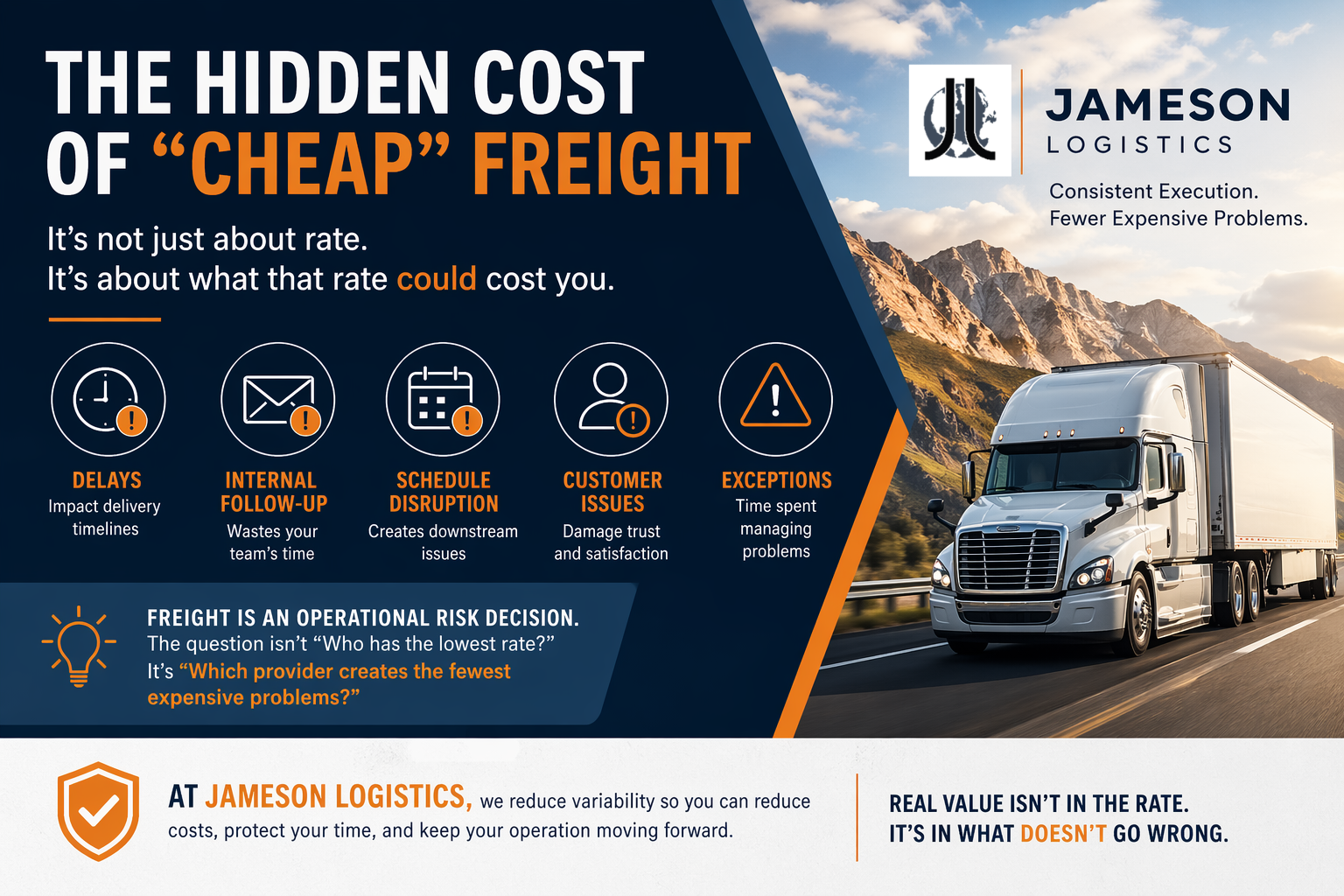
- Delays that impact delivery timelines
- Internal follow-up that eats up your team’s time
- Schedule disruptions that ripple across operations
- Customer issues that damage trust
- Time spent managing exceptions instead of moving forward
That’s why cheaper freight so often becomes more expensive freight.
Why This Keeps Happening
Part of the problem is that most logistics providers sound exactly the same:
- “Reliable service”
- “Competitive pricing”
- “Flexible solutions”
When every option looks identical, buyers are left with only one clear comparison point: price.
So naturally, they choose the lowest rate.
But that decision often leads to higher costs later—just not in a way that shows up on the original quote. It’s something we regularly help customers uncover and correct at Jameson Logistics.
Freight Is an Operational Risk Decision
Freight isn’t just a purchasing decision. It’s an operational risk decision.
Every shipment has the potential to either run smoothly or create disruption. And when issues happen, the cost isn’t just financial—it’s time, attention, and momentum.
If your team is constantly tracking shipments, following up on delays, or reacting to problems, those costs add up quickly. That’s exactly where Jameson Logistics focuses—reducing variability so your team can stay focused on what actually matters.
A Better Question to Ask
Instead of asking:
“Who has the lowest rate?”
The better question is:
“Which provider creates the fewest expensive problems?”
At Jameson Logistics, that’s the standard we hold ourselves to—consistent execution, fewer disruptions, and a proactive approach that keeps your operation running smoothly.
Because the real value in logistics isn’t found in the initial quote—it’s found in what doesn’t go wrong.
If your operation feels reactive instead of controlled, it may be time for a different approach.